
A new Harris Poll reveals strong national respect for skilled trades, despite lingering awareness and image challenges. The findings highlight the essential role of trade education and call for a renewed focus on elevating these vital careers.
In an era often dominated by the pursuit of four-year college degrees, a recent Harris Poll report sheds light on a critical, yet frequently overlooked, segment of the American workforce: skilled trades. The report, titled "American Sentiment Toward The Skilled Trades," released in July 2025, highlights a profound respect for these essential professions, even as they grapple with an image and awareness issue. The key findings of the Harris Poll emphasize the undeniable value of skilled trade education and the urgent need to re-evaluate societal perceptions of these vital careers.
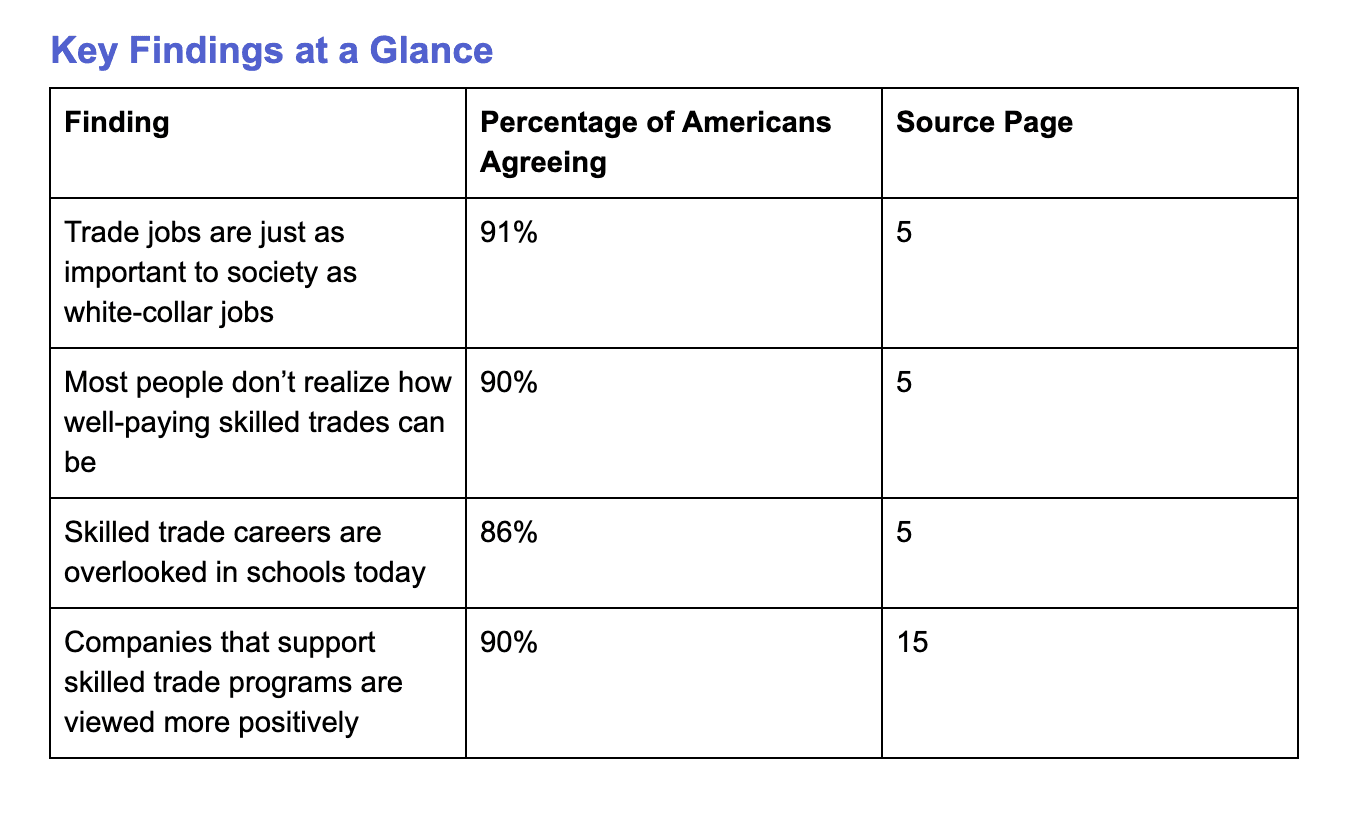
The Harris Poll report reveals a fascinating paradox: while Americans overwhelmingly view skilled trades as essential, these professions are widely perceived as undervalued and overlooked. A staggering 91% of Americans agree that trade jobs are just as important to society as white-collar jobs, with 63% strongly agreeing. This sentiment underscores a deep-seated appreciation for the practical contributions of skilled tradespeople to daily life and the national infrastructure. [1]
Despite this widespread respect, a significant disconnect exists in public perception. The report indicates that 90% of Americans believe most people don’t realize how well-paying skilled trades can be, and 86% agree that skilled trade careers are overlooked in schools today. This suggests a systemic issue where the true economic and societal value of these professions is not adequately communicated or recognized, particularly within educational pathways. [1]
The report further highlights a notable generational divide in the perception of skilled trades. While Boomers (ages 61-79) show a higher confidence (59%) that skilled trades offer the best job opportunities, only 38% of Gen Z (ages 18-28) share this view. This disparity extends to the belief that skilled trades offer a faster and more affordable path to a good career, with 51% of Millennials and 48% of Boomers strongly agreeing, compared to only 36% of Gen Z. [1]
This generational gap is crucial, as it points to a potential future shortage of skilled labor if younger generations continue to overlook these career paths. The report identifies several barriers contributing to this, including the perception of skilled trades as less prestigious, a lack of awareness or interest, pressure to attend a four-year college, and doubts about financial rewards. Gen Z, in particular, expresses unique concerns about job security, automation, and a lack of flexible career options within the trades. [1]
The Harris Poll report, along with other recent studies, underscores the immense value of skilled trade education as a viable and rewarding alternative to the traditional four-year college route. As the cost of higher education continues to soar, trade schools offer a more affordable and direct path to a stable and lucrative career.
One of the most significant advantages of skilled trade education is the accelerated timeline to employment. Unlike a four-year degree, many trade school programs can be completed in two years or less, allowing graduates to enter the workforce and start earning a salary much sooner. [2] This is a crucial factor for many individuals, especially those who are eager to begin their careers and achieve financial independence.
Moreover, the cost of trade school is often a fraction of the tuition at a traditional university. This affordability, combined with the potential for high earning potential, makes skilled trade education a financially sound investment. The Harris Poll report reveals that a significant portion of Americans recognize this, with many agreeing that skilled trades offer a faster and more affordable path to a good career. [1]
Trade schools emphasize hands-on learning and practical experience, which are highly valued by employers. Students are trained in the specific skills and techniques required for their chosen trade, ensuring they are job-ready upon graduation. This practical approach to education contrasts with the more theoretical nature of many university programs, and it is a key reason why trade school graduates are often in high demand.
As one source notes, "Trade schools provide a direct path to mastering these vital skills and offer a rewarding career with strong job security." [3] This hands-on training not only equips students with the necessary technical skills but also instills a strong work ethic and problem-solving abilities, which are transferable across various industries.
The United States is currently facing a significant skilled labor shortage, with many industries struggling to find qualified workers. The U.S. Bureau of Labor Statistics projects substantial growth in skilled trades through 2033, with some roles, such as solar photovoltaic installers, expected to see a 60% increase in demand. [4] This growing demand, coupled with a retiring workforce, creates a wealth of opportunities for individuals with the right skills and training.
By choosing a career in the skilled trades, individuals are not only securing their own financial future but also contributing to the strength and stability of the American economy. As the Harris Poll report suggests, companies have a vital role to play in supporting and promoting skilled trade programs to address this critical workforce need. [1]
The Harris Poll report emphasizes the crucial role that companies play in supporting and promoting skilled trades. Nine out of ten Americans view companies more positively when they back skilled trade programs, highlighting a clear opportunity for corporate social responsibility and brand building. [1]
Companies can make a significant difference in addressing the skilled trades gap by actively supporting hands-on skills training, offering paid internships and apprenticeships, and providing scholarships. These initiatives not only help to develop a skilled workforce but also resonate positively with the public. [1]
The report also touches upon the evolving landscape of education and employment, noting that skills and credentials are becoming just as critical as traditional university degrees. Research conducted by The Harris Poll on behalf of ETS (Educational Testing Service) found that 80% of HR decision-makers globally agree that new skills and credentials will be as valued as a traditional university degree by 2035. Furthermore, 82% believe that micro-credentials – short-term, focused certificates or certifications – will become a valuable way to showcase skills. [1]
This shift in perspective underscores the growing importance of vocational training and alternative educational pathways. It suggests that the traditional emphasis on four-year degrees may be outdated, and that a more diverse approach to talent acquisition, one that values practical skills and certifications, is needed to meet the demands of the modern workforce.
The findings of the Harris Poll report present clear implications for policymakers, educators, and industry leaders. To address the skilled trades gap and ensure a robust future workforce, a multi-pronged approach is necessary.
There is an urgent need to re-evaluate the emphasis placed on four-year college degrees as the sole path to success. Educational institutions, from K-12 to higher education, should actively promote skilled trades as viable, respected, and financially rewarding career options. This includes:
Efforts must be made to combat the perception that skilled trades are less prestigious or financially unrewarding. This can be achieved through:
Government agencies and industry associations have a critical role to play in supporting the skilled trades. This includes:
By working collaboratively, stakeholders can create an environment where skilled trades are not only respected but also actively pursued by a new generation of talented individuals.
This special report from Harris Poll's Corporate Strategy & Reputation Practice is based on an online survey conducted within the United States from June 20-22, 2025, among 2,203 adults aged 18 and older. The sampling precision of Harris online polls is measured by using a Bayesian credible interval, with the sample data accurate to within ±2.5 percentage points using a 95% confidence level. [1]
Source: Harris Poll June 20–22, 2025, Gen Z (N=381), Millennials (N=673), Gen X (N=577), Boomer+ (N=572) [1]
This chart visually represents the generational divide in the perception of skilled trades as a faster and more affordable path to a good career. It highlights the lower agreement among Gen Z compared to older generations, underscoring the need for targeted outreach and education for younger demographics.
The Harris Poll report serves as a powerful reminder of the enduring value of skilled trades and the urgent need to champion these professions. By addressing misconceptions, promoting the benefits of skilled trade education, and fostering stronger partnerships between industry, education, and government, we can ensure a vibrant future for the skilled trades and a robust workforce for generations to come. The unsung heroes of our economy deserve nothing less.
November 2025
Copyright © Mia Share Inc. DBA Lumion

AI in education gets discussed as one story. For trade and technical schools, it's three. Telling them apart is the difference between reacting to noise and acting on the shifts already reshaping how your school runs.

Discover data-driven insights on how trade and technical schools can boost website lead conversion and SMS engagement. Learn how speed, personalization, and smart mobile communication turn prospects into enrolled students.
See how Lumion can help you achieve similar results and drive enrollment growth.
Join hundreds of institutions already transforming their enrollment processes.