
How AI can increase enrollment without increasing headcount

Your team's week vs. the calendar
Every career-school operator I've talked to in the last year has hit the same wall at the same time. Website traffic is up. Inquiries are up. Enrollments have flattened. The default diagnosis is a capacity problem. The default prescription is more admissions reps.
That prescription is understandable. It's also incomplete.
The hiring instinct, and its limits
A new admissions rep in the US costs roughly $47,000 in base salary, according to Salary.com's benchmark. Layered with benefits at the private-industry average of 30 percent, you're at about $67,000 in fully loaded compensation before you've paid for CRM seats, phone lines, management time, or office space. SHRM's 2025 recruiting data puts average nonexecutive cost per hire at $5,475 and time-to-fill at roughly six weeks. That's the entry cost.
The retention cost is worse. CUPA-HR's analysis of higher-ed admissions roles found that 71 percent of admissions coordinators and counselors have been in their position three years or less. NACAC's workplace study found 43 percent of admissions professionals name burnout as the top challenge in their field, with 22 percent citing understaffing right behind it. You're not just hiring. You're constantly hiring.
None of that makes hiring a bad choice. But it makes hiring an incomplete answer to a problem that isn't only about headcount.
The 128-hour coverage gap
Here's the shape of the actual problem.
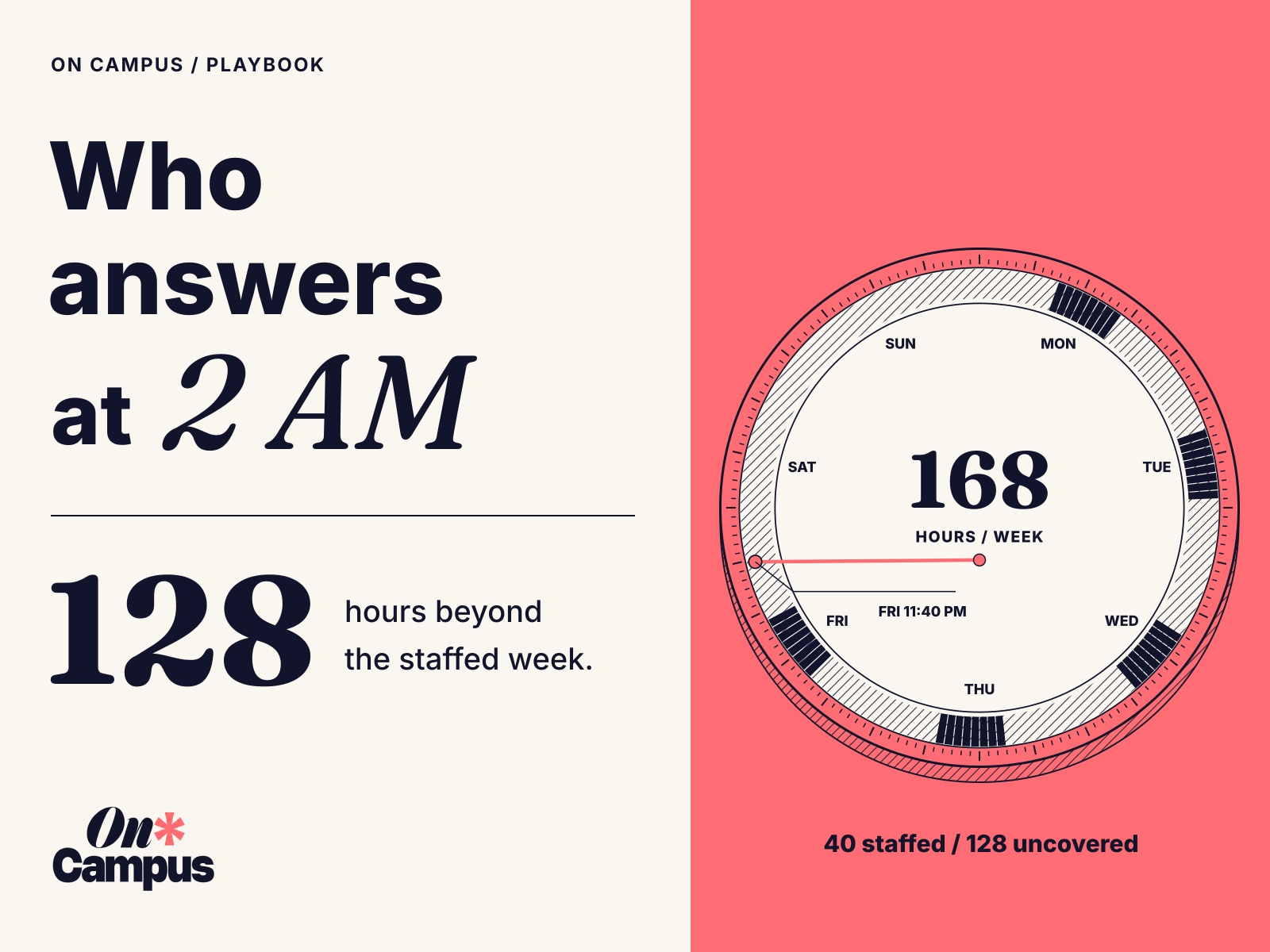
There are 168 hours in a week. A well-staffed admissions team covers 40 of them. That leaves 128 hours a week when a prospective student can inquire, ask a question, or make a decision, and nobody at your school is on shift to respond. That's 76 percent of the calendar sitting uncovered.
Students inquire on their own time. Mongoose's 2025 higher-ed benchmark, drawn from more than 600 institutions and 133,000-plus chatbot conversations, found that 47 percent of all higher-ed chatbot conversations happen after hours. Admissions replies peak twice during the day: once at 1–2 pm, and again at 8–9 pm. At four-year institutions, Saturday reply rates are eight times lower than Monday's, not because demand vanishes on weekends, but because staff coverage does.
When higher-ed conversations happen vs. when admissions teams are on
The pattern holds across two-year institutions too, with a broader daytime peak from 10 am to 3 pm and the same Saturday drop. Same calendar. Same coverage gap.
This isn't a staffing problem. It's a calendar-shape problem. Your students are asking questions across all 168 hours. Your team is available for 40 of them.
What students actually expect
The gap wouldn't matter if students were patient. They aren't.
Ruffalo Noel Levitz surveyed 1,600 prospective online students in 2024–2025 about response-time expectations. 25 percent expect a personalized response within minutes of inquiring. Another 20 percent expect it within three hours. 30 percent give you up to 24 hours. Only 25 percent are willing to wait longer than a day.
That's three-quarters of your prospective students expecting some kind of personalized answer within a business day. It's one in four expecting it within minutes.
How fast prospective students expect a personalized response
The evidence for what happens when you don't deliver is layered. In higher ed, EAB found that when institutions moved adult-completion lead delivery from a weekly cadence to a daily one, response rates lifted 37 percent, purely because reps could reach students while intent was still fresh. Mongoose's data associates two-way text conversations with a 7.5x higher likelihood of enrollment compared to one-way notifications, though that's an association from proprietary data, not a controlled experiment.
Adjacent-industry evidence is starker. Harvard Business Review's 2011 study of B2B sales response times found that firms contacting web leads within one hour were nearly seven times as likely to qualify them as firms waiting another hour, and more than 60 times as likely as firms waiting 24 hours. InsideSales' analysis of 5.7 million inbound leads across 400+ companies found conversion rates were eight times higher when contact happened in the first five minutes versus the five-minute-to-24-hour window.
The evidence isn't identical. Sales-lead qualification isn't the same as career-school enrollment. But the direction is consistent: fast response is causally linked to qualification in adjacent industries and associatively linked to enrollment in higher-ed.
Why hiring alone can't close the gap
Doubling your admissions team doesn't close the 128-hour gap. It changes the shape of the 40 covered hours.
Even a team of 20 reps is going to work business hours most of the week. You can add evening shifts. You can rotate weekend coverage. Both help. Neither one gives you continuous, always-on response across the 128 hours you don't currently staff.
The economics keep getting worse in that direction, not better. Private-industry wages rose 3.4 percent and benefits 3.5 percent year over year through Q1 2025 per SHRM's summary of BLS employment cost data. Turnover in higher-ed staff overall was 14 percent in 2023–24 per CUPA-HR, above the pre-pandemic 12 percent baseline. Every rep you hire is a rep you'll likely be replacing within three years. The 128-hour gap is architectural. It's not something you hire your way out of.
What AI actually does in admissions today
The word AI carries a lot of freight. What it actually means in career-school admissions right now is more specific than the freight suggests.
Adoption isn't hypothetical. UPCEA and EducationDynamics' 2025 marketing-and-enrollment survey found that 65 percent of respondents use AI in their work, up from 40 percent in 2024. Of those users, 62 percent reported improved efficiency and 52 percent reported improved work quality. Ruffalo Noel Levitz's 2024 online-programs report found that 40 percent of institutions had already deployed an AI chatbot, and another 28 percent planned to within a year. Ivy.ai's survey of 613 higher-ed administrators across 48 states found that among institutions using chatbots, 51 percent apply them to admissions inquiries specifically, and 92 percent of chatbot users reported reduced inquiry response times.
The specific capabilities showing up in career-school admissions today:
- AI on the website that can hold a real conversation with a prospective student, name specific programs, discuss cohort dates, and book a tour. Not an FAQ pop-up.
- AI-drafted replies inside the admissions inbox that a rep reviews, edits, and sends. Not automated blasts.
- AI outbound sequences that re-engage stale leads with personalized outreach at scale, without adding a rep.
None of this replaces the admissions team. It extends the team's reach into the 128 uncovered hours.
The customer proof
Clayton State University added AI agents to its admissions workflow and grew enrollment 7 percent year over year without adding a single new admissions position, according to Element451's published customer story. In the first semester, staff time spent on routine communications dropped 75 percent. That's the exact pattern the thesis of this piece describes.
Texas State Technical College reports 33 percent enrollment growth across eight consecutive semesters after deploying AI-supported admissions conversations across 11 campuses, with 31,000-plus conversations handled and 1,160 staff hours saved. Their cost per submitted application dropped from $424 to $81. Southeastern University's pilot AI reached 100 percent of leads it was assigned, saved 38,863 minutes of staff time in two months, and consolidated tools for a reported $200,000 in annual savings.
These are vendor-published customer outcomes. They're not controlled trials, and each institution made multiple changes simultaneously. Read them as directional evidence, not causal proof.
Three schools. Same pattern.
The pattern extends beyond higher ed. Podium's AI Employee has handled more than 1 million after-hours leads across local businesses, saved 246,000-plus hours, and booked 190,000-plus appointments. Impel's analysis of 230-plus auto dealerships found a 27 percent lift in appointment-set rate and a 26 percent lift in lead-to-sale conversion after AI adoption. Across verticals, the operational pattern is consistent: respond immediately across nights and weekends, absorb routine questions, sustain follow-up without queue fatigue, route higher-intent cases to people, and increase throughput without matching headcount growth.
What changes when you deploy this
First-response time becomes a 24/7 number, not a "during business hours" number. That's the shift.
For most career schools, first-response time is currently measured against a business-day baseline. Deploy AI on the website and in the inbox, and that same metric now applies to Sunday at 10 pm the same way it applies to Wednesday at 10 am. "We respond in under five minutes, day or night" becomes a defensible service-level standard, and a defensible enrollment differentiator.
The roles your admissions team keeps are the ones that were always the highest-leverage. Judgment calls on complex cases. Financial counseling with a family navigating co-signer questions or Title IV gaps. Relationship building with the applicant who's on the fence between two schools. Closing high-intent tours. The AI handles first-touch, qualification, and the volume of routine follow-up. Your reps handle the calls that determine whether a student enrolls.
What changes when AI enters the admissions workflow
The team doesn't shrink. The team's focus concentrates.
The five moves, and why now
If you're deciding whether to move on this, five things are worth doing before you evaluate a specific vendor:
- Audit your after-hours leak. Pull 30 days of form fills, chat inquiries, and phone calls. Tag them by hour and day. Look at what happened between 5 pm Friday and 8 am Monday. That's your gap. Most schools don't know its size until they measure it.
- Pick one channel to extend with AI first. Website chat is usually the highest-volume and lowest-risk starting point. Get one channel dialed in before extending to email or voice.
- Set the AI-to-human handoff rules explicitly. "AI handles X. Route to a human when Y triggers." Not vague. Not "we'll figure it out."
- Measure response-time-without-hiring. Track first-response time across every channel with the AI on. Compare to your pre-AI baseline. That's the number the AI is accountable for.
- Reframe the budget conversation. Stop asking "can we afford another rep?" and start asking "can we extend the reps we have?" The unit economics of adding an AI layer are structurally different from the unit economics of adding a person. Neither is universally better. They solve different problems.
The timing matters. Workforce Pell activates July 20, 2026. The Department of Education's final rule estimates an average 187,000 recipients annually, with modeled short-term-certificate enrollment growth of 3 to 13 percent depending on how many recipients are genuinely new students. That volume is coming into a system that already has a 128-hour coverage gap. If the gap is unmanaged, more inquiries will make it worse, not better.
Lumion's Web Agent runs on your school's own content and knowledge base and holds admissions conversations on the site 24/7. Mia drafts admissions replies inside the Unified Inbox for your reps to review, edit, and send. Outbound Agents and Voice are rolling out on Enroll Pro this year. If you'd like to see how it fits your admissions workflow, book a demo or talk to us.
Read next
Who answers at 2 AM: designing coverage for the 128 hours
Most career schools cover 40 of the 168 hours a prospect might inquire. Adding shifts moves the wall. This playbook lays out the coverage grid: what an agent answers alone, what waits for a human, and how Monday morning picks up Friday night.

How to Optimize Career School Operations with Technology
How career schools can streamline finances and fuel growth using connected tools for payouts, forecasting, scheduling, and security.


Maximizing Revenue: Tips for Optimizing Tuition Collection in Career Schools
Four essential tips for career schools to streamline payment processes, boost collections, and support financial stability.